Free admission
Artists: Helene Førde and Tone Andersen
Curator: Camilla Løken Hill
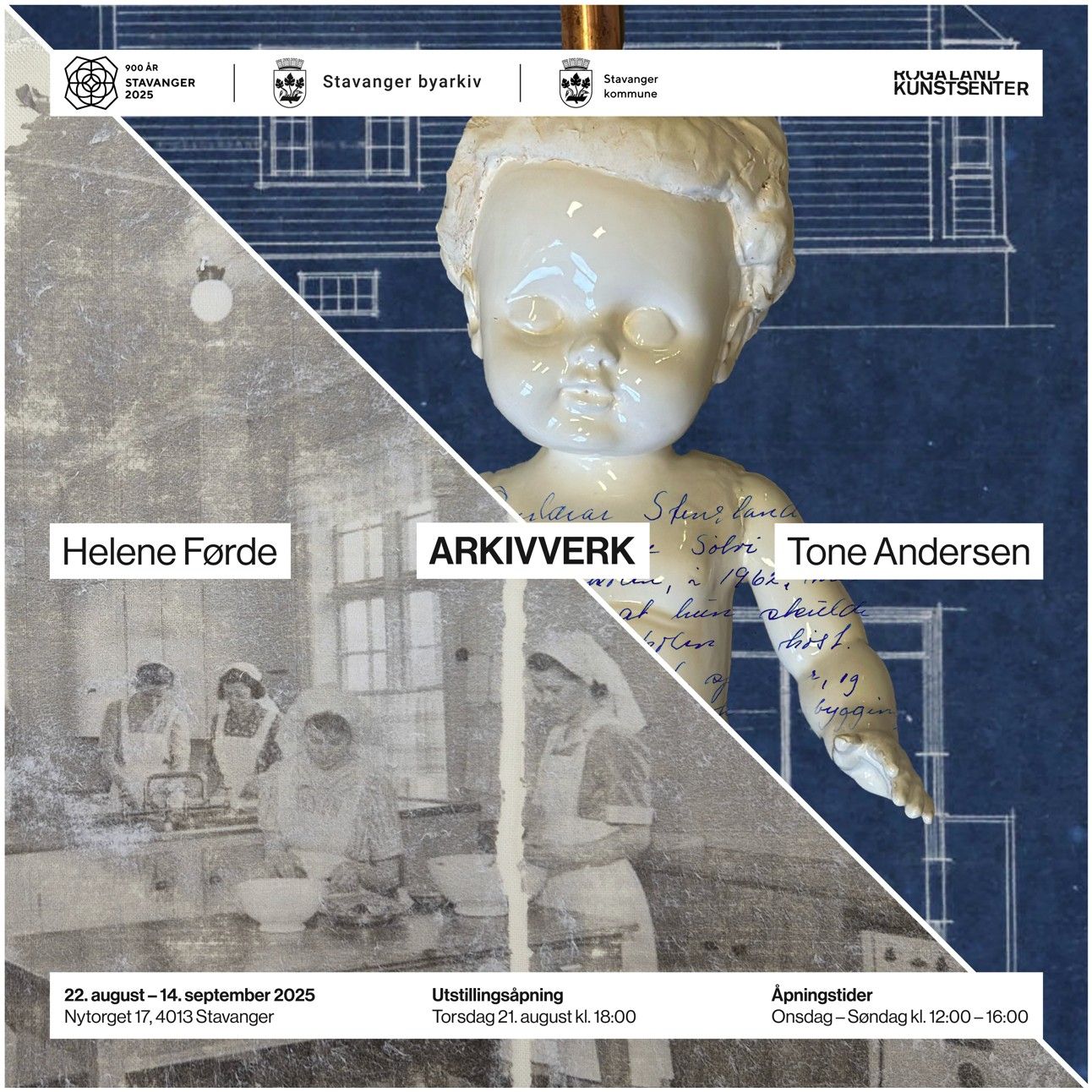
Rogaland Kunstsenter is delighted to invite you to the exhibition ARKIVVERK with Tone Andersen and Helene Førde. In autumn 2023, Rogaland Kunstsenter and Stavanger byarkiv invited contemporary artists in Scandinavia to apply for an artist residency in Stavanger, with a duo exhibition at the art centre in autumn 2025. The two Bergen-based artists Tone Andersen and Helene Førde were selected, and for six weeks they were free to explore the city archive's resources, which would later be developed into artworks. Two years on, they are presenting the result of an exciting collaboration between two very different professional fields.
The exhibition is part of the city's anniversary, marking 900 years since Stavanger became a city in 2025, and aims to make parts of Stavanger's history visible to the public through an artistic lens — perhaps making us more curious about what archives, and art, can be. You can find more information about the project in this video:
{"@context":"http:\/\/schema.org\/","@id":"https:\/\/rogalandkunstsenter.no\/2025\/07\/04\/utstilling-arkivverk\/#arve-html5-","type":"VideoObject","contentURL":"http:\/\/rogalandkunstsenter.no\/wp-content\/uploads\/2025\/07\/rks_-_byarkiv_kunstneropphold-1080p.mp4"}
About the exhibition (curator's text)
Two artists and one city archive. The result is ARKIVVERK — an exhibition of artworks created in the encounter between the artistic mind and the archive.
The archive is a place where the past is preserved, and a carrier of information that may prove useful in the future.
Archive creators are those responsible for handling the documents and other information that together make up an archive.
Tone Andersen has gathered letters, diaries, photographs and personal objects from three women who lived in different historical periods, all with a connection to Stavanger. From this material she has created artistic reflections on themes of time, identity and historical visibility. The three women are represented by three different works in a room with an enveloping video installation. Many will recognise old toys and dolls from Lærdal's toy factory, which the artist has translated from plastic into large ceramic sculptures. This evokes memories while at the same time raising questions about today's consumer culture and our overconsumption of plastic, among other things. Through an interactive sculpture, visitors are invited to activate a sound that may be familiar to many, as it is linked to a symbol of great importance to one of the kommuner in the region. Andersen has personal reasons for the selection of materials she has worked with, which has produced an authentic experience of her journey through the archive. Her installation is divided into two rooms, which she calls the light room and the dark room. The dark room is a poetic approach to women's inner lives. The light room belongs to childhood and to constructed life, with its expectations and frames.
Helene Førde has also taken a personal approach to the material she sought out in Stavanger Byarkiv. Her own experience with weaving, and an earlier encounter in Ørland with Frida Hansen's work and her transparency technique, were deepened through the residency. She immersed herself in the story of the Køhler family's wealth and bankruptcy. The stock market crash of the late 1800s contributed to women entering the workforce. Helene Førde has explored how the rise of industry in Stavanger and the female workforce influenced social upheaval and the development of the women's movement. Initially, women were not permitted to operate advanced machinery, and they were excluded from wage negotiations, but membership in the labour movement led to a growing awareness of women's rights. Both the sunflower and the dandelion have been used as symbols of the women's movement, and in her work Førde has used the dandelion as a motif in her installation. The weaving she shows is connected to Frida Hansen and the translucent, in which historical events and lives are woven into one another. It tells the story of the transition from craft to industry from a women's perspective, and draws our attention to how certain events can bring about major changes in society.