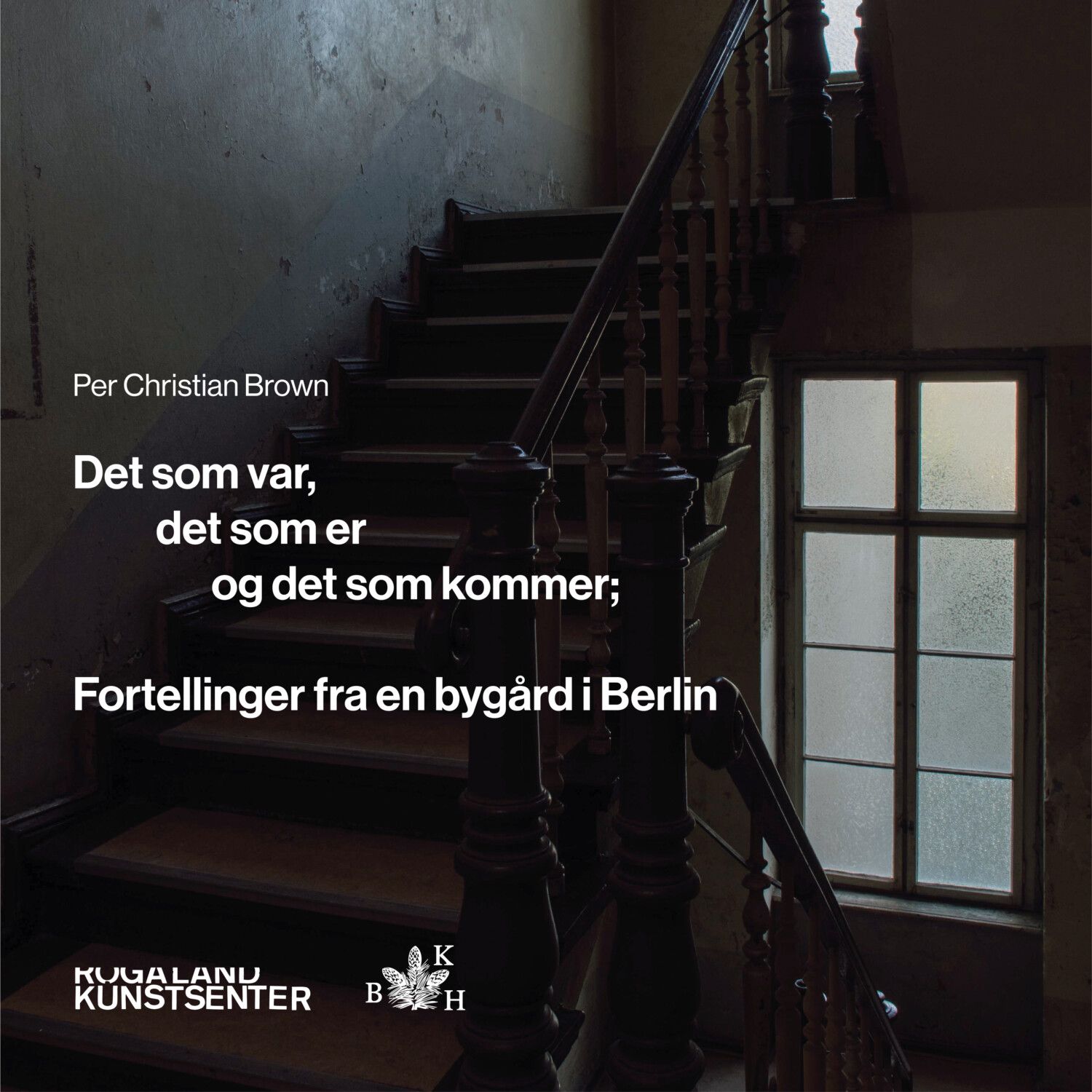
Rogaland Kunstsenter is proud to present the exhibition Det som var, det som er og det som kommer – Fortellinger fra en bygård i Berlin (2025) by Per Christian Brown, opening Thursday 20 November 2025.
The exhibition is a video- and photo-based time document examining the building stock and residents of an apartment house in Prenzlauer Berg, Berlin. Through portraits and interviews with the residents, it captures both the larger and smaller stories – about everyday life, ageing, neighbourhood and change. The project explores how history, memory and time live on in people and in the things that surround us.
The project is supported by Atelier Nord, Norsk fotografisk fond, Billedkunstnernes Vederlagsfond, Stavanger kommune and Bildende Kunstneres Hjelpefond (BKH). BKH recognises the artistic quality of his project, as well as his contribution to the regional art scene in Rogaland. Read more about the jury's reasoning.
In connection with the exhibition we invite you to an Artist Talk with Per Christian Brown on Saturday 23 November. More information.
About the exhibition
Det som var, det som er og det som kommer – Fortellinger fra en bygård i Berlin (2025)
By Per Christian Brown
The project "Det som var, det som er og det som kommer" is a video- and photo-based time document examining the building stock and residents of the apartment house where I myself live, in the Prenzlauer Berg district of Berlin. I moved here in 2006 with my German partner, and although I now mainly live in Oslo, I still consider this apartment and the building one of my homes. Here I have put down roots and spent close to twenty years of my life.
Through close collaboration and good relationships with my neighbours, I have been able to realise an extensive project consisting of ten portraits and interviews with residents of the building. They span a wide range in age and experience – from young people in their 20s to a woman of nearly 90 who was born and raised in the apartment where she still lives. The stories reveal a diversity of lives: some have only recently moved in, while others have lived through the entire DDR era, with all that entailed of surveillance, fear, but also community. Several tell of a stronger sense of solidarity and mutual help, a form of community that many feel has disappeared today.
The apartment house at Saarbrücker Strasse 13 was built in the 1880s, during the reign of Kaiser Wilhelm I, and is a classic example of German Gründerzeit architecture. It has stood witness to Germany's dramatic upheavals – from the empire and the economic crisis following the First World War, through the frivolity of the Weimar Republic, to the destruction of the Second World War and the founding of the DDR in 1949. After the fall of the Wall in 1989, the building stood with "unknown owner" until an inheritance dispute was settled, and was sold to a private investor in 2012. Today the façade has been restored to its original splendour, but the interior still bears clear traces of the passage of time – more than sixty years without major refurbishment.
The building and the people who live there together form a living archive. Through interviews and observations I try to capture both the larger and smaller stories – what it is like to live as a tenant in a building with so many layers of history, and how our surroundings shape who we are. A central theme in the project is the role of objects: the things we surround ourselves with as carriers of memory, belonging and identity. Simple everyday objects such as potholders, clothes, books, pictures or gramophone records can serve as gateways to larger stories about life, work, family and memory.
Objects have their own cycle – they are produced, used, discarded, found, inherited or given away – and in this circulation they connect people and eras. They reflect parts of life and are both practical tools and symbolic memory-carriers. "Det som var, det som er og det som kommer" is therefore not only about one building in Berlin, but about how history, memory and time live on in people and in the things that surround us. Through the video interviews, personal stories are conveyed about everyday life, ageing, neighbourhood and change – about a community that bears witness to the unrest of the world behind old brick walls.